What Are Pinnipeds?
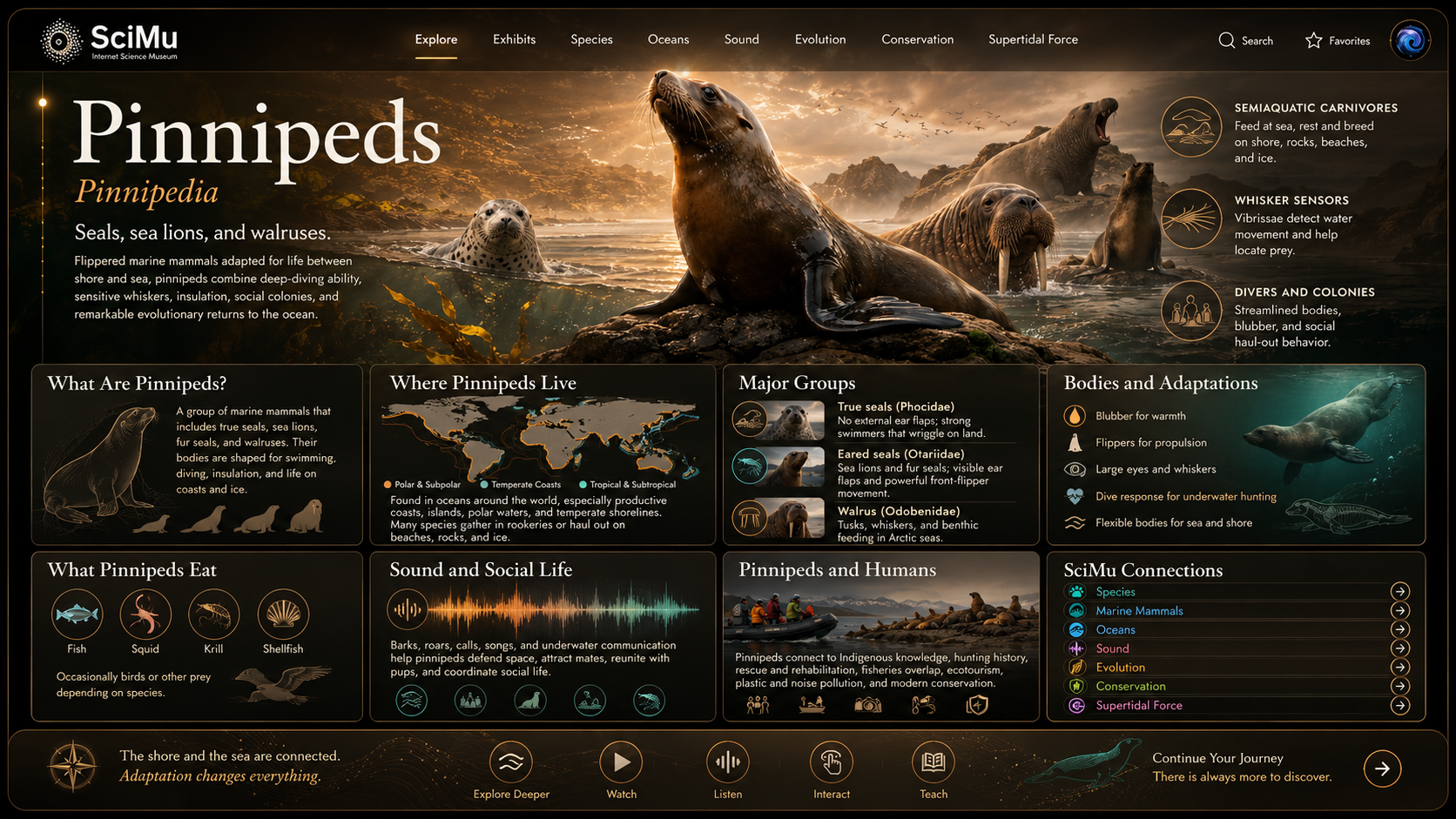
A group of marine mammals that includes true seals, sea lions, fur seals, elephant seals, and walruses. Their bodies are shaped for swimming, diving, insulation, and life on coasts and ice.
Pinnipedia
Pinnipeds are flippered marine mammals adapted for life between shore and sea, including true seals, sea lions, fur seals, elephant seals, and walruses.
A group of marine mammals that includes true seals, sea lions, fur seals, elephant seals, and walruses. Their bodies are shaped for swimming, diving, insulation, and life on coasts and ice.
Pinnipeds live in oceans around the world, especially productive coasts, islands, polar waters, and temperate shorelines. Many species gather in rookeries or haul out on beaches, rocks, and ice.
True seals / Phocidae include harbor seals, monk seals, leopard seals, Weddell seals, and elephant seals. Eared seals / Otariidae include sea lions and fur seals. Walrus / Odobenidae has tusks, whiskers, and Arctic benthic feeding.
Blubber for warmth, flippers for propulsion, large eyes and whiskers, dive response for underwater hunting, and flexible bodies for moving through sea, shore, rock, and ice.
Fish, squid, krill, shellfish, and sometimes birds or other prey depending on species, location, season, and hunting strategy.
Barks, roars, calls, songs, and underwater communication help pinnipeds defend space, attract mates, reunite with pups, and coordinate social life.
Pinnipeds connect to Indigenous knowledge, hunting history, rescue and rehabilitation, fisheries overlap, ecotourism, plastic and noise pollution, and modern conservation.
Species, Marine Mammals, Oceans, Sound, Evolution, Conservation, and Supertidal Force connect this page to the wider museum.
Design Study
This image is an early visual concept for how a future SciMu pinnipeds page could feel: part encyclopedia, part museum exhibit, part interactive science guide. The working page above is the current coded version; this design study is a visual target for future versions.